



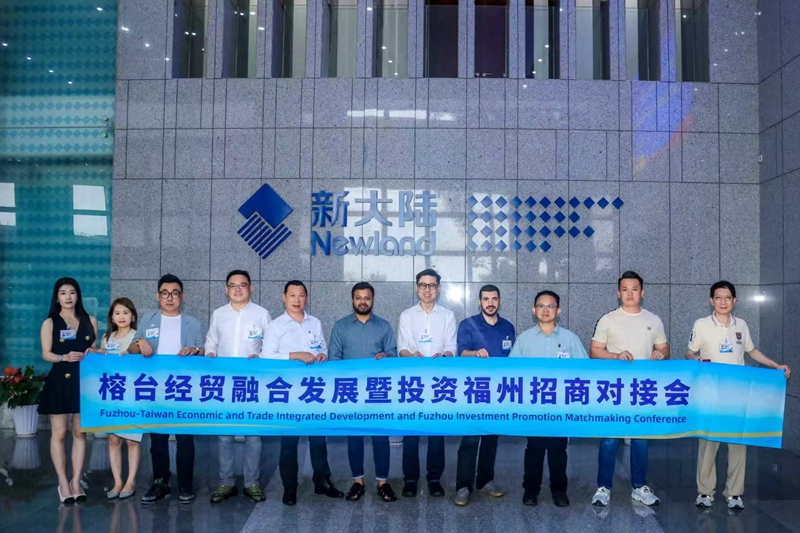
Representatives from Taiwan-funded enterprises, foreign-invested companies, industry associations, and experts visit Fujian Newland Communication Science Technology. [Photo provided to chinadaily.com.cn]
The successful convening of the Fuzhou–Taiwan Economic and Trade Integration Development and Fuzhou Investment Promotion Matchmaking Conference on May 23 marked another significant milestone in the deepening of cross-Strait economic cooperation.
The conference was one of five thematic investment promotion events within the framework of the 2026 Fuzhou International Investment Month and the 28th Cross-Strait Economic and Trade Fair, running from May 21 to June 21.
The month-long investment campaign, anchored by a fair with nearly three decades of institutional history, underscores Fuzhou's sustained efforts to enhance its position as a cross-Strait economic hub over the long term.
Attended by more than 200 representatives from Taiwan-funded enterprises, foreign-invested companies, and industry associations, and experts from sectors such as the digital economy, biomedicine, finance, and logistics, the conference was designed to create new opportunities for industrial collaboration and investment. More importantly, it reflected a broader vision of building stronger economic ties across the Taiwan Strait while promoting high-level opening-up and regional development.
As a teacher and researcher of international trade and investment, I had the opportunity to participate in related activities and conduct field visits to several important development projects, including the Fuzhou-Matsu Industrial Cooperation Park in Lianjiang county, the Newland Technology Group Science and Technology Park in Mawei district, Lianjiang's Port, and the Lianjiang Hulu Island Deep-Sea Fishing Base. These visits provided valuable insights into how Fuzhou is transforming policy initiatives into tangible economic opportunities.
From a trade and investment perspective, the conference was not merely a promotional event. It represented a practical mechanism for transforming policy support into business opportunities. The announcement that 260 investment project leads had already been identified, with work already well underway on 88 projects — including 14 Taiwan-funded projects — demonstrates investors' growing confidence in Fuzhou's development prospects. In an increasingly competitive global investment landscape, such achievements indicate that Fuzhou is positioning itself as a preferred destination for capital, technology, and industrial cooperation.
The conference's emphasis on Taiwan-related investment deserves particular attention. Cross-Strait economic relations have long been characterized by deep commercial ties, integrated supply chains, and strong people-to-people exchanges. Fuzhou, due to its geographical proximity, cultural affinity, and historical connections with Taiwan, possesses unique advantages in promoting economic integration. The city's efforts to attract Taiwan-funded businesses and facilitate industrial cooperation have the potential to contribute not only to local economic growth but also to greater economic connectivity across the Strait.
Theory is one thing. The reality on the ground, visible through site visits conducted around the conference, tells a more granular story. One of the most noteworthy destinations was the Fuzhou-Matsu Industrial Cooperation Park in Lianjiang county. The park serves as a vivid example of how regional cooperation can create new economic opportunities. By leveraging the close geographic proximity between Lianjiang and Matsu, the park aims to establish a platform for investment, logistics, trade, tourism, and industrial collaboration. Such initiatives demonstrate how localized cooperation can support broader regional integration objectives while generating practical benefits for businesses and communities. This is not speculative development; it is operational integration.
Equally impressive, a visit to Newland Technology Group's science park in Mawei district underscored Fuzhou's credibility in the digital economy space. Newland is not a showcase firm propped up for foreign visitors — it is a major technology conglomerate with roots in barcode-scanning hardware, which is now expanding operations across IoT, fintech, and smart-city infrastructure. Its presence is a reminder that Fuzhou's digital economy pitch already has homegrown champions, not merely aspirations. Its achievements in digital payment systems, smart technologies, and digital transformation illustrate how technological innovation can serve as a catalyst for economic growth. For international investors seeking opportunities in China's digital economy, Fuzhou offers a dynamic environment supported by strong policy incentives and growing market demand.
The visit to Lianjiang's port facilities further underscored the strategic importance of maritime infrastructure in regional development. Ports remain essential gateways for international trade, and efficient logistics networks are increasingly critical in an era of evolving global supply chains. Fuzhou's continued investment in port development and maritime connectivity strengthens its role as a transportation and logistics hub within the Maritime Silk Road framework. Improved connectivity not only facilitates trade between the Chinese mainland and Taiwan but also enhances Fuzhou's capacity to serve wider Asia-Pacific markets.
Another important highlight was the visit to the Hulu Island Deep-Sea Fishing Base in Lianjiang. The facility demonstrates how traditional marine industries can be transformed through technological upgrading and industrial modernization. Deep-sea fishing, seafood processing, cold-chain logistics, and export-oriented production have been integrated into a comprehensive marine economic ecosystem. This reflects China's broader strategy of developing the marine economy as a new source of sustainable growth. For investors, such projects showcase opportunities in sectors that combine technological innovation with resource-based industries.
What makes Fuzhou particularly attractive from an investment perspective is its ability to integrate multiple growth drivers into a coherent development strategy. Cross-Strait cooperation, digital innovation, marine economic development, logistics modernization, and industrial upgrading are mutually reinforcing components of a broader vision for regional growth. Rather than pursuing isolated projects, Fuzhou is building an ecosystem that encourages collaboration among governments, businesses, research institutions, and investors.
Zoom out, and the conference fits into a pattern that Fujian province has been cultivating for years — the construction of a cross-Strait economic integration corridor that operates semi-independently of the political relationship between Beijing and Taipei. The instruments are familiar, such as special economic zones, preferential policies for Taiwan-funded enterprises, infrastructure investment, and the cultivation of diaspora networks. But the execution has grown more sophisticated. The explicit framing of this year's activities around high-level opening-up and new momentum for cross-Strait industrial synergy reflects an awareness that integration needs to be sold not on sentiment alone, but on substance.
In trade and investment, location is fate — until policy and infrastructure conspire to make it destiny. Fuzhou is making that leap, and the rest of the region would do well to pay attention.
Mohammad Saiyedul Islam, PhD, is a senior lecturer and researcher at the School of Overseas Education (School of Foreign Languages), Sanming University, Fujian province, China, and an adjunct fellow in the ASEAN-China Research Centre at the University of Indonesia in Indonesia.

Copyright © General Office of Fujian Provincial People's Government
Website Identification Code 3500000049Registration Number: 15003084
All rights reserved. The content (including but not limited to text, photo, multimedia information, etc) published in this site belongs to fujian.gov.cn.
Without written authorization from fujian.gov.cn, such content shall not be republished or used in any form.
