




The 25th "Chinese Bridge" Chinese Proficiency Competition for Foreign College Students is held in Xiamen, Fujian province. CHINA DAILY
When Levi Benjamin Petersen was in high school, the first Chinese character that truly caught his attention appeared on a tin of tea imported from China.
It was fu, meaning good fortune.
The German teenager did not know what it meant, but was fascinated by its intricate yet orderly structure. Why was it written this way? He wondered. Did Chinese words change with tense, as they did in German and English?
Petersen could not speak Chinese then, nor could he have imagined that his fascination with a single character would begin a journey that would eventually take him to China.
Years later, in a tea garden in Fuzhou, Fujian province, Petersen touched a tea plant for the first time. He learned to pick and process tea with local masters and the custom of tapping one's fingers on the table to express thanks when tea is poured.
Days later, Petersen stood on top of the podium at the global finals of the 25th "Chinese Bridge" Chinese Proficiency Competition for Foreign College Students in Xiamen, Fujian, where he was named the overall champion.
This year marks the 25th anniversary of the Chinese Bridge competition. Since overseas preliminary rounds began in February, more than 50,000 university students from over 140 countries have taken part.
A total of 157 contestants reached the global finals, joined by 131 members of observer delegations.
From Aug 5 to 23, participants traveled through Beijing and Fujian's Pingtan, Fuzhou, Zhangzhou and Xiamen. Their experiences ranged from visits to the Palace Museum and the National Museum of China to tea gardens, Tulou (earthen buildings), university campuses and technology companies.
The competition itself extended well beyond vocabulary and grammar, featuring quizzes, stand-up performances, talent shows, workplace experiences and themed debates.
At the global finals, Minister of Education Huai Jinpeng said that over the past quarter-century, Chinese Bridge had grown into a bridge connecting China and the world through history, culture, science and technology, ecology and openness, while promoting friendship and mutual learning among young people.
Born in Germany in 1998, Petersen began learning the drums at the age of 8. For years, becoming a professional drummer seemed to be the path ahead.
Then the COVID-19 pandemic brought it to an abrupt halt. Performances were canceled and work opportunities disappeared. As a freelance musician in his early 20s, Petersen suddenly found himself unsure about the future.
"I was in my 20s and felt like I hadn't even properly found my footing yet. Then, almost overnight, it felt as if there was no future ahead," he says.
During that difficult period, he returned to an interest that had first emerged years earlier — Chinese characters.
In 2021, Petersen enrolled at the University of Hamburg to study Sinology. Chinese was no longer simply a hobby. It became the beginning of a new plan.
His musical background also shaped the way Petersen learned Chinese.
To him, Chinese words resembled melodies, with tones distinguished by changes in pitch. Learning music, he says, had taught him how to remember sounds and replay them accurately in his mind.
He applied the same method to Chinese, putting sentences on an A-B repeat loop and repeating them until the sounds flowed naturally.
After two years of study in Germany, Petersen came to China for the first time in 2023 for a one-month summer program at Henan Normal University. Although he had excelled in handwriting and dictation, everyday conversations quickly exposed a weakness.
"I could write every character people were saying, but when I listened, I was always half a beat behind," he recalls.
Back in Germany, he changed his approach. He spent less time copying characters and immersed himself in Chinese short videos, hiding the subtitles, guessing the meaning and then checking his understanding.
Gradually, he realized that mastering Chinese was about more than vocabulary and grammar. The real challenge was learning to think and respond naturally in the language.
That lesson proved crucial when he entered Chinese Bridge.
At first, Petersen regarded the German preliminary competition simply as a chance to test himself. But after winning the German division, he began preparing seriously for the global finals.
He realized he was effectively facing two competitions: one testing Chinese-language ability and the other knowledge of Chinese history and culture.
He developed two parallel study plans, strengthening his listening, speaking, reading and writing while systematically reviewing Chinese history, idioms and cultural knowledge.
On trains in Germany, he could often be found studying idiom cards designed for Chinese primary school students. Rather than simply memorizing their meanings, he traced the historical figures and stories behind them.
The preparation eventually brought him to the final stage.
In the talent show, Petersen sang and played the drums to Tuotai Huangu (A Complete Transformation), a song from the animated film I Am What I Am 2. The film's spirit of perseverance had deeply influenced him when he first watched it during his year of study at Peking University. Throughout the exhausting months of preparation, rehearsing the song repeatedly reminded him not to give up.
After four rounds of competition, Petersen and American contestant Elijah Scott Marx advanced to the final round, a rapid-fire round with 20 questions. Petersen eventually won by a margin of one question.
Yet the competition was about more than a championship.
Contestants from different countries used Chinese to share their experiences, ideas and views of the future.
Speaking about artificial intelligence and creativity, Marx says, "The most important thing is that humans must hold the steering wheel."
Kai Shand Marsh of Australia reflected on his experience with lacquer-thread sculpture and compared language learning to a voyage of self-growth.
"Learning a language is a journey of cultivating the mind," he says. "Don't rush and don't be anxious. The slow work that may seem clumsy will eventually become the foundation on which we communicate with the world."
For Petersen, some of the most memorable moments came off the competition stage.
In Pingtan, participants planted 25 friendship trees and five trees symbolizing affection and remembrance. But the tea gardens of Fuzhou held particular meaning for him.
As a teenager, Petersen had first become fascinated by Chinese characters because of the fu on a tea tin. Now he had arrived in Fuzhou, the birthplace of Fuzhou jasmine tea, where he could pick and process tea himself and learn the customs surrounding the tea table.
"If I had come to China by myself, I definitely wouldn't have had access to experiences like these," he says.
Chinese characters, tea and culture had moved beyond the textbook and become something he could touch, taste and experience firsthand.
Following his victory, Petersen began an internship with a German company in Shanghai.
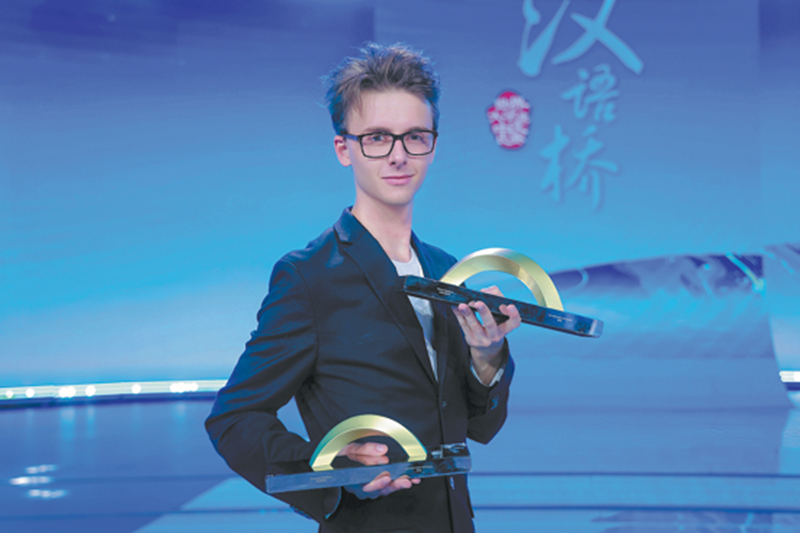
Levi Benjamin Petersen celebrates after winning the overall championship. CHINA DAILY
He plans to graduate from the University of Hamburg next summer before returning to China for further study. He hopes to enroll in a Chinese-taught graduate program, possibly in economics or business administration.
"Winning the championship has made me even more certain that I want to come to China for further study," he says.
"My future career will definitely have something to do with China and the Chinese language."
During his preparations for the competition, Petersen often slipped into the corridor between train carriages in Germany to recite Tang Dynasty (618-907) poetry aloud. Those verses became another way for him to understand China — and, increasingly, himself.
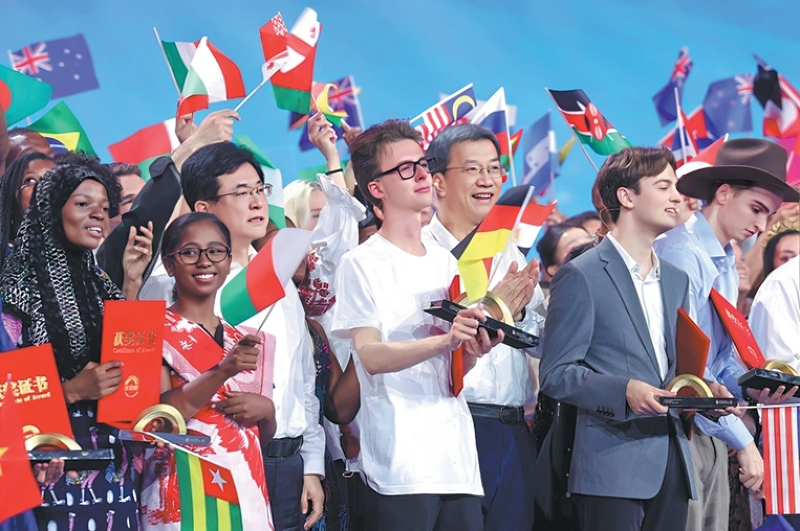
Finalists celebrate together at the competition. CHINA DAILY
From Hamburg to Beijing, from a tea garden in Fuzhou to the stage in Xiamen, Chinese has taken him far beyond the classroom.
It helped a young German drummer who had lost his way find a new path.
What began with a single Chinese character has become a bridge — to China, to the world and to the future he now sees for himself.

Copyright © General Office of Fujian Provincial People's Government
Website Identification Code 3500000049Registration Number: 15003084
All rights reserved. The content (including but not limited to text, photo, multimedia information, etc) published in this site belongs to fujian.gov.cn.
Without written authorization from fujian.gov.cn, such content shall not be republished or used in any form.
